

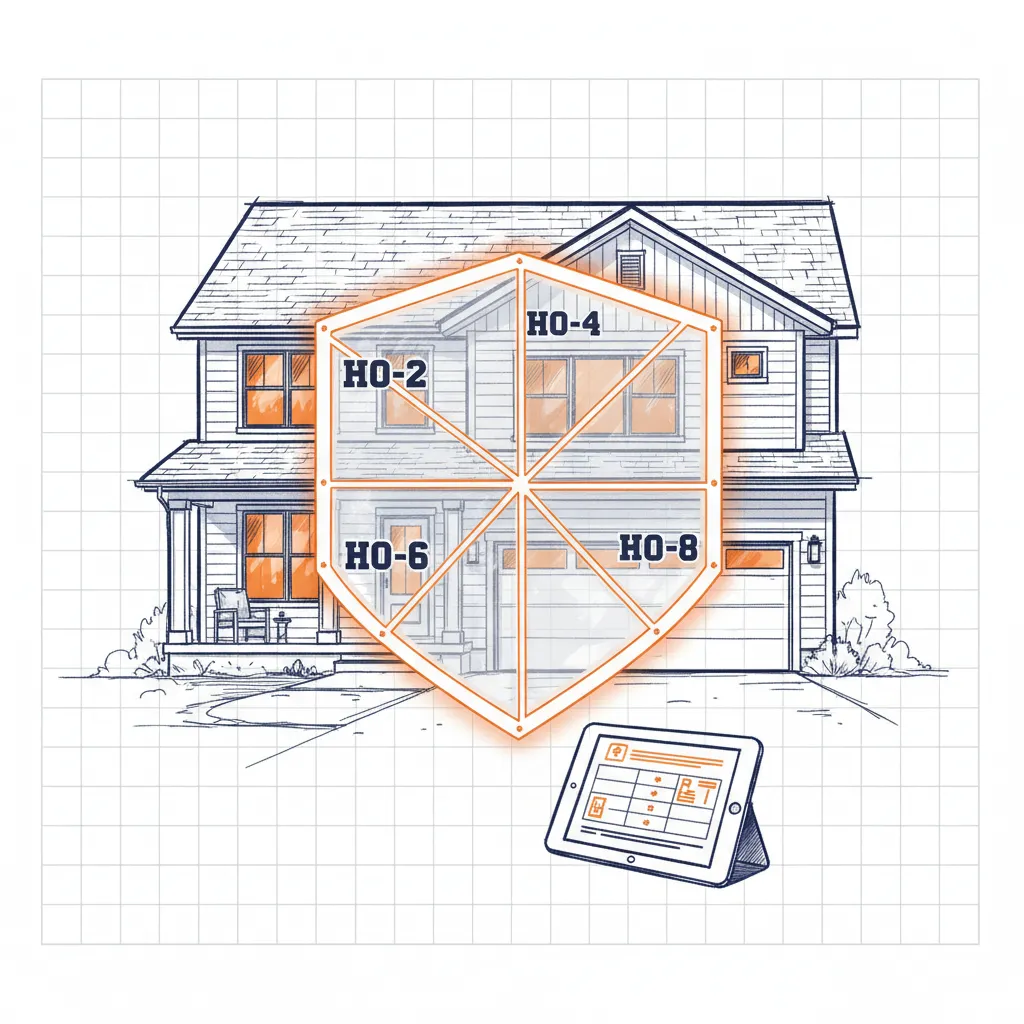
The Foundation of Your Financial Fortress: Decoding Coverage Types
Your home represents a significant pillar of your financial legacy, but the insurance policy protecting it is the bedrock. Misunderstanding the structural components of that policy creates foundational cracks that can destabilize your entire net worth. We will dissect the three critical distinctions that define the strength of your coverage: peril type, valuation method, and coverage scope. Mastering these concepts is the first step toward building an impenetrable financial fortress.
Named-Peril Coverage: The Basic Blueprint
Named-Peril Coverage, a foundational insurance structure, protects your home and possessions *only* from the specific risks, or “perils,” listed in the policy. This blueprint typically includes 10 to 16 perils, such as fire, lightning, windstorms, hail, theft, and vandalism. If a loss occurs from an event not explicitly named in your contract, the policy provides zero financial response. The burden of proof rests on you to demonstrate that the damage was caused by a covered event. This model offers baseline protection but leaves you vulnerable to any unforeseen or unlisted threat, functioning as a moat with only a few sections filled.
Open-Peril Coverage: The Comprehensive Shield
Open-Peril Coverage, a comprehensive liability shield, reverses the insurance equation to your advantage. It protects your assets against all potential causes of loss *except* for those specifically excluded in the policy document. Common exclusions include events like floods, earthquakes, intentional damage, and neglect. With this structure, the burden of proof shifts to the insurer; they must prove that the cause of your loss is part of the explicit exclusion list. This “all-risk” approach provides a far broader and more resilient defense, creating a fortress designed to withstand both known and unknown threats on the horizon.
Actual Cash Value vs. Replacement Cost: Rebuilding vs. Recouping
The valuation method determines the financial resources you receive after a catastrophic event, whether you have the capital to rebuild your life or are left with a significant financial gap. Understanding this distinction is operationally critical.
- Actual Cash Value (ACV), a recoupment-focused valuation, reimburses you for an item's current worth after factoring in depreciation. A 7-year-old roof or a 5-year-old laptop will be valued at its used-market price, not its original cost. ACV policies leave you to fund the difference required to purchase new items, directly eroding your capital reserves.
- Replacement Cost Value (RCV), a rebuilding-focused valuation, provides the full capital required to replace a damaged item with a new, comparable one at current market prices. RCV ensures your financial position is restored without forcing you to liquidate other assets or downgrade your quality of life. For any professional building a long-term legacy, RCV is the only strategically sound option.
| Valuation Method | Financial Outcome | Strategic Implication |
|---|---|---|
| Actual Cash Value (ACV) | Pays for damaged property's depreciated value. | Creates a cash shortfall, forcing out-of-pocket spending to rebuild. Weakens your financial position. |
| Replacement Cost Value (RCV) | Pays the full cost to replace property with new, similar items. | Makes you whole again, preserving your capital and standard of living. Fortifies your financial position. |
Architecting Your Protection: The Four Core Policy Blueprints
The insurance industry uses standardized policy forms, designated “HO” for homeowners, to structure coverage. While eight primary forms exist (HO-1 through HO-8), only four are strategically relevant to the modern professional. The others, like the bare-bones HO-1 and HO-2, are obsolete artifacts, while HO-7 (Mobile Home) and HO-8 (Older Home) are niche solutions. We will focus on the four core blueprints that constitute the modern asset protection landscape.
HO-3 (Special Form): The Industry Standard Foundation
The HO-3 policy, the industry's default foundation, offers a hybrid of coverage types. It provides robust, open-peril protection for your home's physical structure (the dwelling) but only named-peril protection for your personal property (your contents). This creates an immediate and often overlooked vulnerability. While a burst pipe damaging your walls would be covered, the same event destroying your electronics and furniture might not be. The HO-3 is a decent starting point, but it fails to provide cohesive protection, leaving the contents of your castle less protected than the walls.
HO-5 (Comprehensive Form): The Executive-Grade Fortress
The HO-5 policy, an executive-grade fortress, elevates your protection to a comprehensive standard. It applies open-peril coverage to *both* the dwelling and your personal property. This unified approach eliminates the critical gap inherent in the HO-3 policy. An HO-5 is engineered for individuals whose assets inside the home, art, technology, professional equipment, high-end furnishings, are as valuable as the structure itself. It typically includes higher liability limits and defaults to Replacement Cost Value, making it the superior blueprint for safeguarding a substantial financial legacy.
HO-4 (Renters Policy): Securing Your Assets, Not the Structure
The HO-4 policy, a strategic asset shield for renters, is designed to protect your belongings and liability within a property you don't own. A common mistake is assuming the landlord’s policy provides any protection for you; it does not. The landlord's insurance covers the building itself, leaving your personal property, from furniture to financial assets, completely exposed. An HO-4 policy erects a barrier, providing named-peril coverage for your possessions and critical liability protection against lawsuits, ensuring a rental decision doesn't become a multi-million dollar liability.
HO-6 (Condo Policy): Fortifying from the Walls-In
The HO-6 policy, a specialized “walls-in” fortification, is essential for condominium owners. Your condo association's master policy protects the building's exterior and common areas, but your responsibility begins at the interior walls. An HO-6 covers your unit's interior structure, including flooring, cabinetry, and fixtures, as well as your personal property and liability. Crucially, it also includes loss assessment coverage. This feature provides capital if the condo association levies a large assessment against all owners to cover a major shared loss that exceeds its master policy limits. Without it, you are financially exposed to the risks of the entire complex.
The Strategic Decision Matrix: Aligning Your Policy with Your Ambition
Choosing a policy is not a consumer decision; it is an executive one. The right policy structure is a direct reflection of your asset level, risk tolerance, and long-term financial objectives. A generic policy is a blueprint for failure. A tailored policy is a tool for wealth preservation.
Asset Level Analysis: Why HO-5 Is the Strategic Default for Professionals
The choice between an HO-3 and an HO-5 policy is a clear strategic inflection point. The HO-3 asks, “Is this specific risk on my list of covered perils?” The HO-5 asks, “Is this risk on my short list of exclusions?” This shift in perspective is everything. For professionals, executives, and business owners, the value of assets accumulated over a career demands the broader protection of an HO-5. The modest difference in annual cost is insignificant when measured against the potential for a multi-six-figure uncovered loss.
The Strategic Default FrameworkStep 1: Set the Baseline. Default to an HO-5 policy with Replacement Cost Value. This establishes comprehensive protection as your starting point, not an upgrade.Step 2: Calibrate Liability. Ensure personal liability limits meet or exceed your net worth. Augment with an umbrella policy to shield against catastrophic litigation.Step 3: Justify Deviation. Only consider an HO-3 if a rigorous analysis confirms your personal property value is low and you are willing to personally absorb the financial risk from any uncovered, non-listed peril.
Liability Coverage: Your Shield Against Unforeseen Financial Threats
Personal liability coverage is arguably the most critical component of a homeowners policy. It is the shield that protects your entire balance sheet, your home, savings, investments, and future earnings, from a devastating lawsuit. A visitor slipping on your walkway or a family member causing an accident can trigger litigation that far exceeds the standard $100,000 or $300,000 limits found in most policies. For high-earners, liability limits must be viewed in the context of total net worth. The strategic solution is a two-layer defense: a primary homeowners policy with at least $500,000 in liability, fortified by an Umbrella Policy, a secondary liability shield, that provides an additional $1 million to $10 million in protection.
Scheduled Personal Property: Protecting Your Most Valuable Possessions
Standard homeowners policies impose strict, low sub-limits on high-value items. For example, coverage for jewelry theft is often capped at just $1,500. A Scheduled Personal Property endorsement, an itemized coverage rider, removes these limitations. This endorsement provides specific, “all-risk” coverage for inventoried valuables, such as fine art, jewelry, collectibles, or high-end electronics, at their appraised value. This ensures your most significant personal assets are not subject to the policy's general limits or deductibles, closing a common but dangerous gap in asset protection.
Moving Beyond the Blueprint: Constructing a Resilient Financial Legacy
An insurance policy is not a static document you file and forget. It is a dynamic component of your financial architecture, one that must be integrated and stress-tested to ensure it performs under pressure. A disconnected policy is a “paper legacy”, a plan that offers the illusion of security but will fail when executed.
Integrating Your Home Policy into a Cohesive Financial Plan
Your homeowners policy must operate in concert with your auto, umbrella, and life insurance policies. The liability limits should be stacked correctly, with the umbrella policy providing a seamless layer of protection over the others. The dwelling coverage amount must be tied to current rebuilding costs, not market value or your mortgage balance. This integrated approach transforms disparate policies from a collection of receipts into a cohesive, interlocking defense system. We engineer this cohesion, so you can achieve strategic certainty instead of just buying coverage.
Scheduling a Strategic Review to Fortify Against a 'Paper Legacy'
Your life is not static, and your risk profile evolves with every success. A home renovation, the acquisition of a valuable asset, a new business venture, or an inheritance can instantly render your existing coverage obsolete. We mandate an annual strategic review to realign your protection with your current reality. This process pressure-tests your existing structure, identifies gaps created by life changes, and fortifies your financial fortress against emerging threats. A strategic review ensures your policy remains a resilient shield, not a brittle, outdated document, safeguarding the legacy you work so hard to build.