

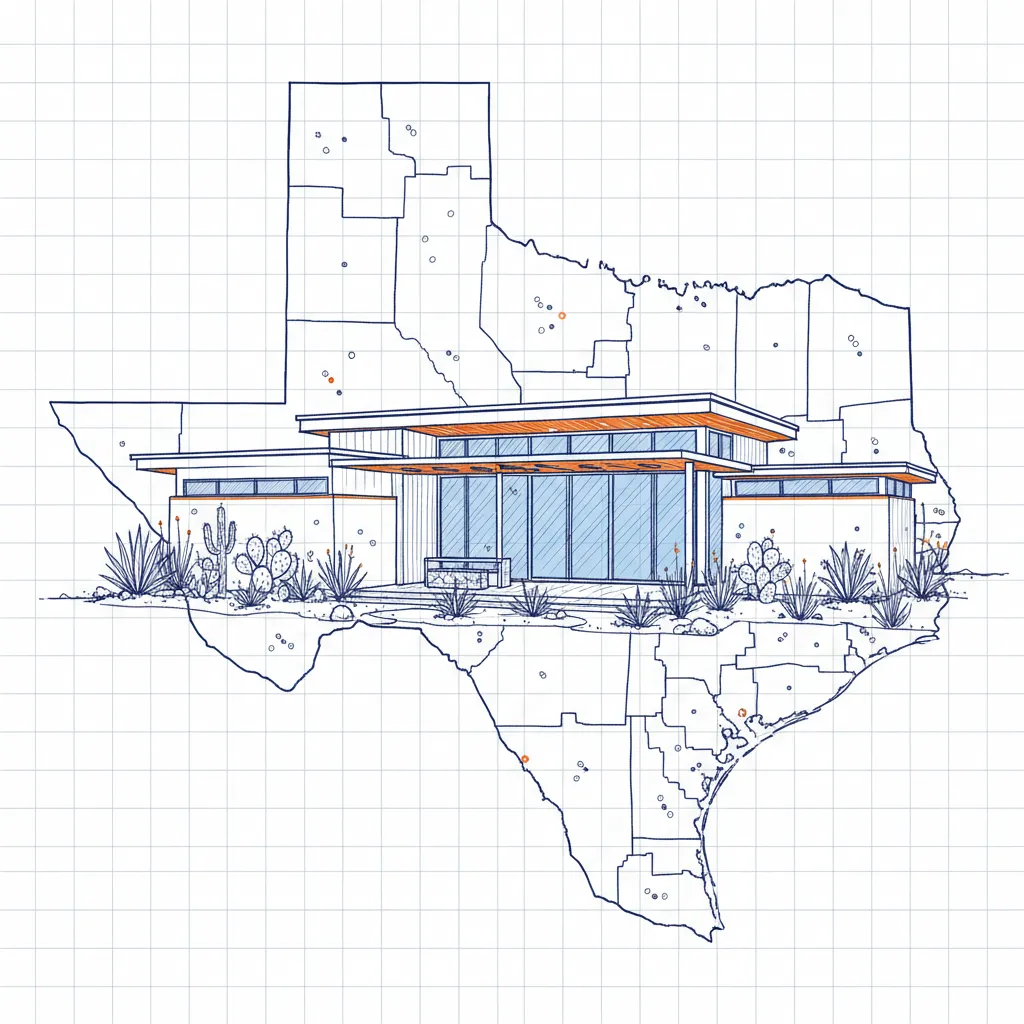
Establishing Your Baseline: Average Home Insurance Costs Across Texas
Your home's location is the foundation upon which its risk profile is built. While many view insurance cost by ZIP code as a simple line item, we see it as the starting point for a strategic conversation. That conversation starts with real numbers: see our Texas insurance pricing ranges. Averages across Texas provide a baseline, but they obscure the critical vulnerabilities unique to your specific location. Understanding these regional distinctions is the first step in constructing a financial fortress that addresses real-world threats, not just meets a lender's requirement.
An insurance policy based solely on a ZIP code average is incomplete. It represents a structure built without a blueprint, leaving your life's work exposed. The goal is to move beyond the baseline and architect a cohesive defense that accounts for the nuanced risks of your specific geography, from the hurricane-prone coast to the hail-battered plains of North Texas.
Cost Analysis: Dallas-Fort Worth Metroplex
The Dallas-Fort Worth (DFW) Metroplex sits at the heart of what meteorologists call "Hail Alley." This geographic reality makes severe convective storms a predictable, high-frequency risk, not a rare event. For homeowners in Dallas, Tarrant, Collin, and Denton counties, this translates into some of the highest insurance costs in the nation. The primary driver is the relentless threat of catastrophic roof and property damage from hail, which can often exceed one inch in diameter. A single storm can generate billions in insured losses, a cost that is socialized across all policyholders in the region.
Suburban sprawl further complicates the risk calculus. As communities expand, the distance to the nearest fire station and the availability of fire hydrants can vary dramatically. This directly impacts a property’s Fire Protection Class rating, a critical metric underwriters use to gauge risk. Furthermore, while violent crime may be concentrated in urban cores, property crime rates in affluent suburbs create a persistent threat of theft and vandalism, adding another layer to the underwriting assessment. A policy for a home in Southlake (76092) must account for a different risk profile than one in Fort Worth's urban center (76102), even though both face the same overarching weather threats.
Cost Analysis: Houston & The Gulf Coast
Along the Texas Gulf Coast, the dominant risk is singular and immense: hurricanes. For properties in Harris County, Galveston, and surrounding coastal areas, the threat of wind and storm surge dictates the entire insurance landscape. Standard home insurance policies explicitly exclude flood damage and often have separate, higher cost-sharing mechanisms for wind and hail damage. This creates a critical gap in coverage, a breach in the fortress wall, that leaves homeowners dangerously exposed.
To secure a coastal property, a multi-layered defense is required. This often involves sourcing a standard policy for fire and theft, a separate windstorm policy, and a federal flood insurance policy. The Texas Windstorm Insurance Association (TWIA), a state-managed insurer of last resort, provides a crucial backstop for wind and hail coverage when private insurers deem the risk too high. For homeowners in ZIP codes like 77554 (Galveston) or 77058 (Clear Lake), navigating this fragmented market is not just about finding coverage; it's about building a cohesive shield against catastrophic financial loss. The cost reflects the potential for a total loss event, a risk fundamentally different from the frequent but less absolute threats seen inland.
Cost Analysis: Austin-San Antonio Corridor
The I-35 corridor between Austin and San Antonio presents a unique and evolving risk profile. Fueled by rapid population and economic growth, this region faces threats shaped by its distinct geography. The Texas Hill Country is prone to severe flash flooding, a danger distinct from the slow-rising storm surge of the coast. Intense, localized rainfall can overwhelm creeks and low-water crossings in minutes, threatening properties that may not even be in a federally designated floodplain. This makes standard flood insurance a strategic necessity, not an optional add-on.
Simultaneously, the area's rolling hills and expanding suburbs are creating increased wildfire risk, particularly in the wildland-urban interface. Communities in western Travis County (e.g., ZIP code 78738 near Lake Travis) must contend with this growing threat. The rapid development also strains infrastructure, including fire and emergency services. A new subdivision may temporarily have a less favorable fire protection rating until a new station is built, directly impacting insurance costs. For residents in this corridor, a forward-looking strategy must account for these dynamic risks created by both nature and explosive growth.
| Region | Representative ZIP Code | Primary Geographic Risk Driver | Strategic Consideration |
|---|---|---|---|
| Dallas-Fort Worth | 75034 (Frisco) | High-Frequency Hail & Wind | Policy must be structured for frequent roof claims and high material replacement costs. |
| Houston / Gulf Coast | 77554 (Galveston) | Catastrophic Hurricane & Flood | Requires a layered defense of separate policies for wind, flood, and standard perils. |
| Austin-San Antonio | 78746 (West Lake Hills) | Flash Flooding & Wildfire | Standard policies are insufficient; requires supplemental coverage for specific topographical risks. |
The Blueprint of Risk: Deconstructing Geographic Cost Factors
An insurance rate is not an arbitrary number. It is the output of a complex underwriting blueprint that quantifies your specific risk exposure. Insurance carriers are, at their core, data companies. They build sophisticated models that analyze dozens of variables to predict the likelihood and severity of a future claim. Your ZIP code is merely the first layer of this analysis. The true cost is determined by deconstructing the specific threats within that geography, the storms on the horizon, the security of your perimeter, and the readiness of your community's defenses.
Understanding this blueprint empowers you to move from a reactive consumer to a strategic partner in your own risk management. By identifying the key factors that define your risk profile, you can take deliberate action to mitigate those threats and, in turn, construct a more resilient and cost-effective defensive structure. This is the difference between simply having coverage and commanding a cohesive asset protection strategy.
The Coastal Fortress: Hurricane and Flood Exposure
For Texas's 14 coastal counties, windstorm insurance is a non-negotiable component of a resilient financial fortress. Standard homeowner policies almost universally exclude or severely limit coverage for wind and hail damage in these high-risk zones. The Texas Windstorm Insurance Association (TWIA), a state-created entity, acts as the insurer of last resort, providing essential wind and hail coverage when the private market will not. Securing a TWIA policy is not a sign of a problem; it is a strategic necessity to prevent a catastrophic coverage gap.
This coverage addresses the acute physical threat of hurricane-force winds and storm surge. A policy's cost-sharing structure in this environment is critical. Instead of a flat dollar amount for you to pay on a claim, these policies often use a percentage-based formula tied to your home's total insured value. A 2% named-storm amount on a $1 million home means you are responsible for the first $20,000 of a loss. Structuring this component correctly is paramount to ensuring your personal assets are shielded from a major storm event.
The Inland Horizon: Navigating Hail Alley and Tornado Risk
North Texas weather patterns represent a chronic, high-frequency threat to property. Unlike a hurricane, which is a seasonal, forecastable event, severe thunderstorms capable of producing destructive hail can develop in under an hour. This relentless pressure on insurers has reshaped the market. Roof damage claims are the single largest driver of cost, leading carriers to implement specific policy language and cost-sharing structures for them.
Many policies now differentiate between damage from various perils. A fire might be covered in full, but a hail-damaged roof might be subject to a separate, higher cost-sharing requirement or be paid based on its depreciated value rather than its full replacement cost. This fine print can create a sudden, five-figure liability for an unprepared homeowner. A strategic review of your policy must confirm that your roof coverage aligns with the real-world cost of replacement in a market with high labor and material demands following a storm, so you can restore your primary physical asset without liquidating other investments.
Securing Your Perimeter: The Impact of Local Crime Rates
Underwriters analyze hyper-local crime data to assess the risk of theft, burglary, and vandalism. Statistics on property crime from your specific neighborhood directly influence your rates. A home in a gated community with private security will have a different risk profile than a similar home in an area with higher reported incidents. This factor extends beyond simple theft; it also touches on liability. A break-in can lead to other events for which you might be held responsible.
You can directly influence this risk factor. Installing a centrally monitored security system, robust locks, and security lighting are not just deterrents; they are tangible risk mitigation actions that underwriters recognize. Most top-tier insurance carriers offer meaningful rate consideration for homes with these protective features. This allows you to invest in your physical security, so you can simultaneously lower your ongoing asset protection costs.
Building for Resilience: Your Area's Fire Protection Class
A Public Protection Classification (PPC), often called an ISO rating, is a score from 1 (best) to 10 that quantifies a community's fire suppression capabilities. This score is a direct input into your insurance rate. It is determined by the Insurance Services Office (ISO), which evaluates three core areas: the local fire department's equipment and staffing, the area's water supply system (hydrant placement and water flow), and the effectiveness of the emergency communication system. A lower PPC score signifies a more robust and rapid response capability, which translates to a lower risk of a small fire becoming a total loss.
Your home's specific distance to the nearest fire station and fire hydrant are critical data points in this assessment. A property located within 1,000 feet of a hydrant and five road miles of a fire station will achieve a much more favorable rating than a more remote property. While you cannot move a fire station, understanding this factor is crucial when purchasing a new home or evaluating your current policy's structure. It is a foundational element of your property's inherent risk profile.
The Legacy Gauge™ AssessmentThis is not a quote. It is a strategic analysis that maps your current coverage against your total balance sheet. We identify the structural gaps between what your policy covers and what your assets are worth, the critical vulnerabilities that commodity insurance overlooks. The process moves you from 40% protected to the 100% Completion Goal of Strategic Certainty.
Beyond the ZIP Code: Architecting a Resilient Financial Fortress
Your ZIP code and property characteristics establish the baseline risk, but they do not define your strategy. The most significant financial dangers do not arise from a miscalculation of hail frequency; they arise from a fundamental misalignment between your insurance coverage and your family's net worth. Most successful individuals and families are only 40% protected. They have policies, pieces of paper, but no cohesive strategy. The moat around their castle is dry because the auto policy has a low liability limit, creating a path for litigation to seize the assets the home policy is meant to protect.
Achieving Strategic Certainty requires moving beyond the geographic data points and architecting a financial structure where each component reinforces the others. Your home, auto, and liability coverages must function as an integrated system, not as a collection of disconnected bills. This is the blueprint for a true financial fortress, one designed to withstand the pressures of modern litigation and catastrophic loss.
Escaping the 'Good Enough' Trap with a Cohesive Strategy
The standard insurance market treats your policy as a commodity. The goal is to provide a piece of paper that satisfies a mortgage lender for the lowest possible price. This creates what we call a 'Paper Legacy', a portfolio of documents that look complete but are strategically hollow. A 'good enough' policy might replace your roof after a hailstorm, but it does nothing to protect your multi-million dollar investment portfolio after a serious car accident leads to a lawsuit that exceeds your auto liability limits.
This is the most common and devastating gap we encounter. A family's entire life's work can be jeopardized by a single weak point in a $100/month auto policy. Escaping this trap requires viewing insurance not as a series of individual transactions, but as a single, holistic strategy. Cohesion is the key. The Umbrella Policy, a liability shield, must be sized to protect your entire net worth and future income, creating a canopy over all your other policies. Without this integration, your individual policies are just isolated outposts waiting to be overrun.
A Strategic Review to Fortify Your Foundation
A true policy review is not a 15-minute call to compare prices. It is a strategic deep dive into the architecture of your financial life. The objective is to fortify your foundation by ensuring your lines of defense are aligned with the assets they are sworn to protect. We analyze your total balance sheet, risk tolerance, and long-term financial goals, so you can align your liability limits accordingly.
This process stress-tests your current structure against real-world scenarios. What happens if a guest is seriously injured on your property? What happens if a distracted moment behind the wheel leads to a life-altering accident? A fortified foundation has answers for these questions. It ensures that the financial consequences of a single, unfortunate event do not cascade into the loss of a lifetime of work. It transforms your insurance from a necessary expense into a powerful instrument of Strategic Certainty, allowing you to pursue your goals with the confidence that your foundation is secure.