

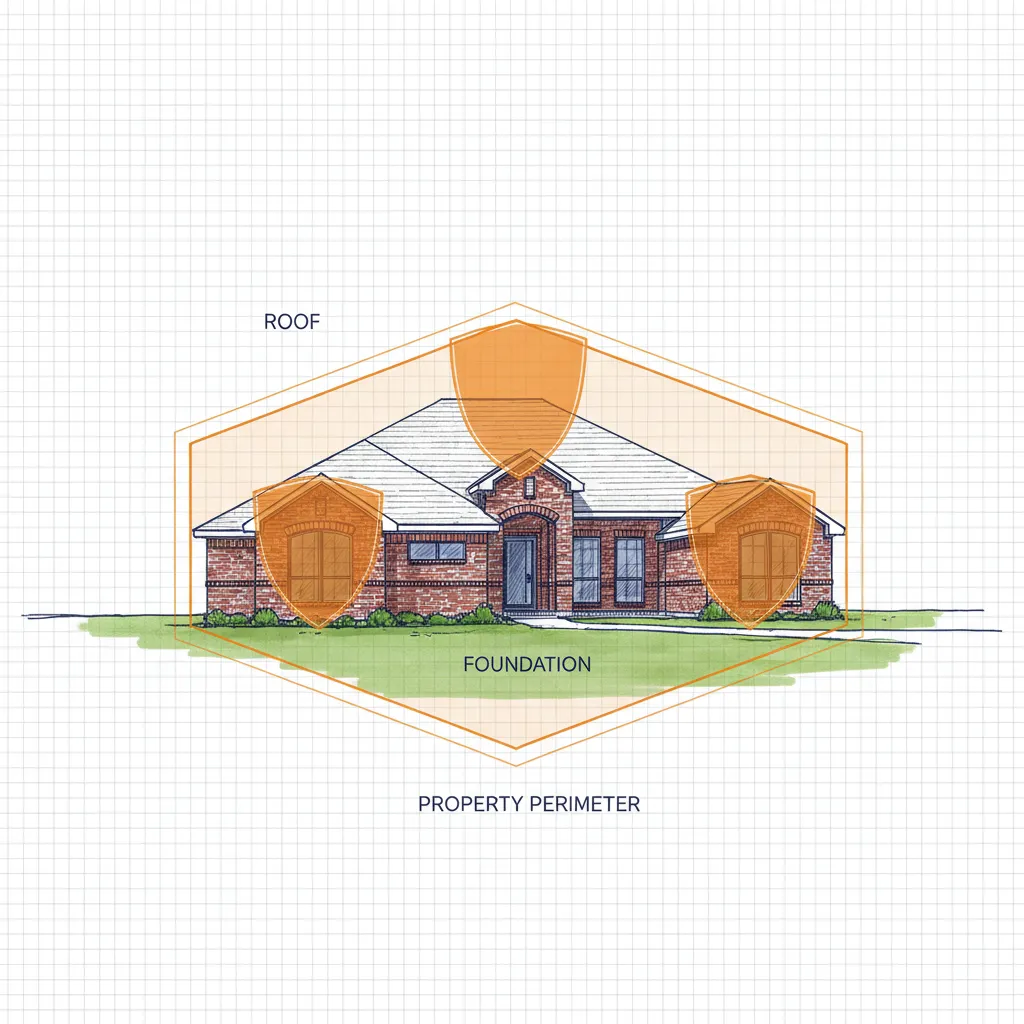
The Foundation: Deconstructing Texas Lender Requirements
Your mortgage lender mandates home insurance for a single purpose: to protect their collateral. This requirement establishes a baseline, not a fortress. The bank’s minimum coverage protects their loan balance, leaving your equity, assets, and financial future exposed. True asset protection begins where the lender’s interest ends. Understanding this distinction is the first step toward building a resilient financial structure.
The Mortgagee Clause: The Bank’s Stake in Your Fortress
The Mortgagee Clause, a standard policy provision, formally names your lender as a financial stakeholder in your property. This clause grants the bank specific rights, including receiving claim payments jointly with you and being notified if the policy lapses. It effectively makes the lender a co-beneficiary of the structural protection, so they can ensure their investment is made whole following a catastrophic loss. This mechanism secures the loan, but it aligns the policy’s primary function with the bank’s balance sheet, not your net worth.
Dwelling Coverage Minimums: Protecting the Loan, Not the Asset
Lenders typically require dwelling coverage equal to your loan balance or the home’s appraised value. This amount is financially insufficient. A home’s reconstruction cost, the actual expense for labor and materials to rebuild, often exceeds its loan balance or market value by 30% or more, especially in volatile markets. This disparity creates a critical underinsurance gap. A policy based on a $500,000 loan balance provides no strategic value when the true cost to rebuild is $750,000, leaving you with a $250,000 deficit and a compromised financial future.
Loss Payee vs. Additional Insured: Defining Financial Interests
Clarity in financial roles is critical for effective risk management. A lender’s position on your policy is carefully defined to limit their rights to just their insurable interest in the physical structure. These definitions dictate how, and to whom, claim funds are disbursed.
| Concept | Strategic Function | Scope of Protection |
|---|---|---|
| Loss Payee | Grants a party (the lender) the right to be included on a claim payment for damaged property. | Strictly limited to the property itself. Provides no liability protection. |
| Additional Insured | Extends your policy’s liability coverage to another entity, defending them if they are named in a lawsuit arising from your property. | Broadens liability coverage. Used for entities like an HOA, not typically for a mortgage lender. |
The Blueprint: Architecting Coverage for Your Full Financial Picture
Moving beyond lender minimums requires a strategic blueprint. This blueprint treats your insurance not as a mortgage compliance document, but as an integrated component of your overall wealth strategy. It shifts the focus from merely covering a loan to defending your entire balance sheet, from the physical structure to your liquid assets. Architecting proper coverage means aligning every policy detail with your specific financial position and risk exposure.
Rebuilding Cost vs. Loan Balance: The Critical Distinction
Replacement Cost Value (RCV), a coverage valuation, funds the full expense to rebuild your home with comparable materials and quality at current prices. It is the only metric that matters for structural protection. Market value is irrelevant; it includes land and is subject to economic trends. The loan balance is a historical figure. RCV is an operational number reflecting today’s construction and labor costs. Securing a policy based on a detailed RCV calculation ensures you can restore your primary asset without liquidating other investments, so you can maintain financial continuity after a total loss.
Strategic Liability Recommendations: Your Shield Against Financial Ruin
Your home policy includes personal liability coverage, but its limits are often insufficient for high-net-worth individuals. A single lawsuit can easily exceed a standard $300,000 or $500,000 limit, placing your savings, investments, and future earnings at risk. The Umbrella Policy, a dedicated liability shield, sits atop your home and auto policies. It provides an additional layer of protection, typically from $1 million to $10 million, activating after the underlying limits are exhausted. This instrument is not a luxury; it is a mathematical necessity to insulate a lifetime of work from a single moment of misfortune.
Ordinance or Law Coverage: Future-Proofing Your Investment
A significant loss often triggers a non-negotiable requirement: rebuilding to current, more stringent building codes. Standard policies do not cover these mandatory upgrade costs. Ordinance or Law Coverage, a critical policy endorsement, addresses this gap. It provides capital to manage the unforeseen expenses of code compliance, preserving your primary coverage for the rebuild itself.
Texas Mandates: Understanding Regional Coverage Fortifications
Texas presents a unique risk landscape. State and federal mandates add specific, non-negotiable layers of protection based on geography. These are not optional coverages but required fortifications for homes in designated high-risk zones. Integrating these policies cohesively into your primary strategy is essential for achieving 100% completion in your financial defense.
Flood Insurance: The Federal Mandate in Designated Zones
Standard homeowner’s policies explicitly exclude damage from flooding. If your property is located in a Special Flood Hazard Area (SFHA) as defined by FEMA flood maps, federal law mandates you carry separate flood insurance. The National Flood Insurance Program (NFIP), a federal entity, provides this primary coverage. Private flood insurance options also exist, sometimes offering higher limits. A critical operational detail is the 30-day waiting period for most new NFIP policies to take effect, so you must secure coverage well before a storm approaches the horizon.
Wind and Hail Coverage: Coastal and Storm Alley Considerations
In Texas’s 14 coastal counties and parts of Harris County, wind and hail coverage is often excluded from standard home policies. Homeowners must secure this protection separately. The Texas Windstorm Insurance Association (TWIA), a state-created insurer of last resort, provides this coverage when it is unavailable in the private market. These policies feature a separate, and often higher, hurricane or named storm deductible, calculated as a percentage of your home’s insured value. Failure to secure and coordinate a separate wind policy creates a catastrophic gap, rendering your primary asset completely unprotected from the region’s most predictable threat.
Executing the Strategy: From Paper Legacy to Financial Fortress
A sound insurance strategy is not static. It is a dynamic plan that must be actively managed. The transition from a collection of policies to a cohesive financial fortress requires disciplined execution and expert oversight. This final phase ensures your protections evolve in lockstep with your success, maintaining a hardened perimeter around your growing asset base.
The Annual Strategic Review: Evolving Your Coverage with Your Career
An annual policy review is a non-negotiable meeting to re-calibrate your financial defenses. This is not a sales call; it is a strategic audit. A promotion, a major home renovation, or significant asset growth can instantly render your existing liability limits inadequate. We conduct this review to identify new exposures and close coverage gaps before they become financial liabilities. This process recalibrates your protection to match your current net worth, so your financial fortress expands as your legacy grows.
Unifying Your Policies: Building a Cohesive Financial Defense
Owning disparate home, auto, and liability policies from multiple carriers creates financial fragmentation. This lack of cohesion results in coverage gaps and conflicting terms that only become apparent during a major claim. Unifying your entire risk portfolio under a single strategic advisor eliminates these vulnerabilities. We construct a holistic defense where each policy works in concert with the others, particularly in how an umbrella policy extends over your home and auto liability limits. This integrated approach transforms a set of individual policies into a singular, impenetrable structure of Strategic Certainty.