
The Foundation: Deconstructing the OEM Endorsement
Your vehicle is a significant asset, engineered with precise components that work in unison. A collision repair introduces a critical variable that can either preserve or permanently degrade that asset's value and integrity. The choice between Original Equipment Manufacturer (OEM) parts and aftermarket alternatives is not a minor detail left to a repair shop; it is a strategic decision that dictates the resilience of your asset. A standard insurance policy defaults to the most cost-effective solution, which systematically erodes your vehicle's foundation.
OEM vs. Aftermarket Parts: The Material Difference in Your Asset's Integrity
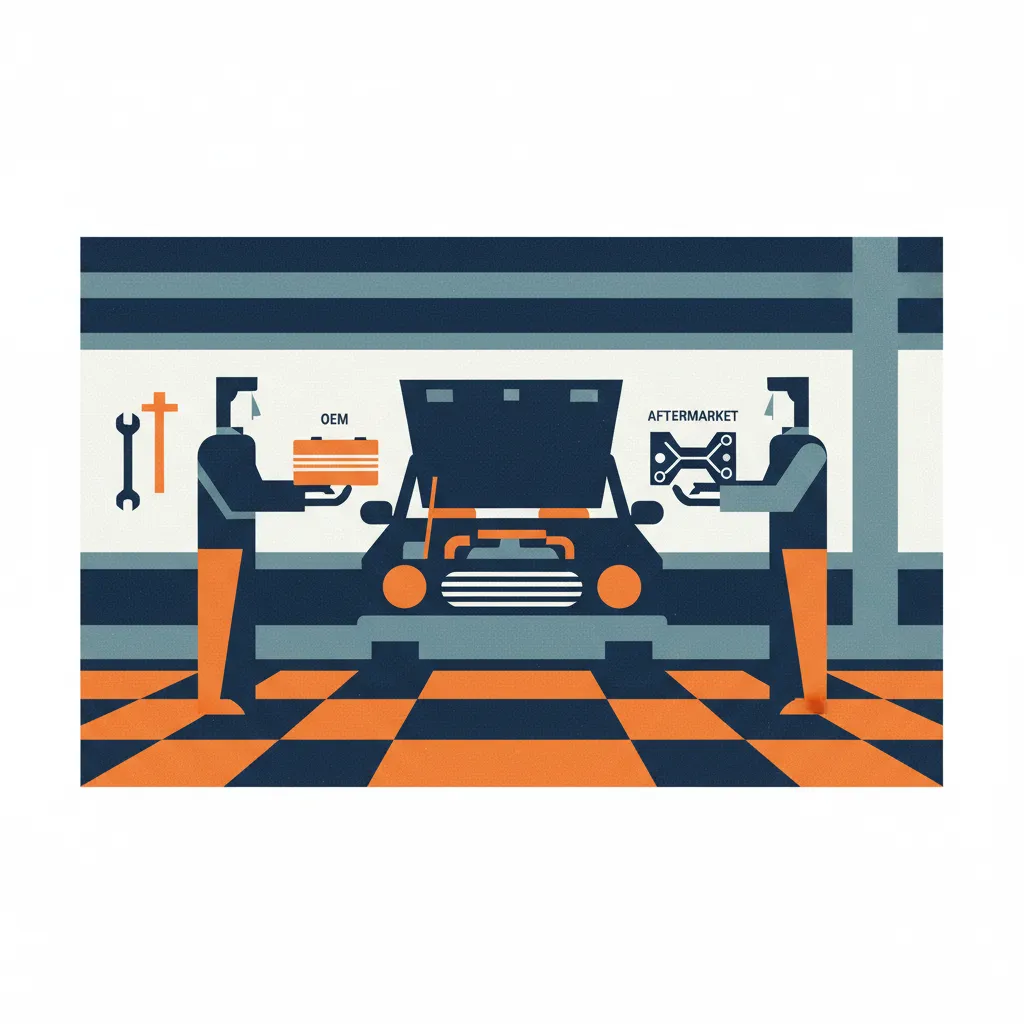
Understanding the components used in a repair is fundamental to protecting your vehicle's long-term value. The distinction between OEM and aftermarket is a matter of origin, engineering, and accountability.
- Original Equipment Manufacturer (OEM) Parts, the same components your vehicle was assembled with at the factory, guarantee a precise fit, finish, and material composition. They maintain the vehicle's structural integrity and ensure all safety systems function as designed by the engineers who built the car.
- Aftermarket Parts, components produced by third-party companies, are designed to replicate OEM parts but often at a lower cost. This cost reduction can come from using different materials, less rigorous testing, or slight variations in dimension, which can compromise fit, performance, and even vehicle warranty.
Using aftermarket parts introduces variables that can cascade into significant issues. A bumper that does not fit perfectly can create unsightly gaps. A hood made from a different grade of metal may not crumple as intended in a future collision. These compromises are unacceptable when protecting a high-value asset.
| Attribute | OEM Parts (Strategic Choice) | Aftermarket Parts (Default Risk) |
|---|---|---|
| Source & Quality | Produced by the vehicle manufacturer; identical to original parts. | Produced by third-party companies with varying quality standards. |
| Fit & Finish | Guaranteed factory-perfect fit, ensuring seamless body lines and function. | May require modification to fit, leading to gaps and misalignments. |
| Warranty Impact | Maintains the original vehicle warranty without question. | Can void vehicle warranty on related components. |
| Resale Value | Preserves market value by maintaining originality and quality. | Contributes directly to diminished value and lower trade-in offers. |
How a Standard Policy Erodes Your Vehicle's Value Post-Repair
A standard auto policy gives the insurer the right to specify aftermarket parts if they are available. This operational default serves the carrier’s bottom line, not your balance sheet. The immediate consequence is a direct hit to your asset’s value. This financial erosion is known as Diminished Value, a permanent loss in a vehicle’s worth after it has been damaged and repaired. A certified collision repair using non-genuine parts leaves a permanent mark on the vehicle's history report. When it is time to sell or trade in, appraisers and educated buyers will identify the use of aftermarket parts and reduce their offers by thousands, recognizing the compromise in quality and integrity.
Calculating the ROI: The Financial Architecture of an OEM Clause
The decision to mandate OEM parts is a calculation of return on investment. You must weigh the small, fixed cost of a policy endorsement against the large, variable risk of asset devaluation. An OEM endorsement, a specific clause added to your policy, mandates the use of genuine parts in all covered repairs, so you can eliminate the risk of substandard components being used to fix your vehicle.
Quantifying the Upfront Investment vs. Long-Term Value Retention
The additional premium for an OEM endorsement is nominal, often ranging from $40 to $80 per year depending on the vehicle. Compare this fixed cost to the potential loss. On a $70,000 luxury SUV, the diminished value resulting from a moderate collision repaired with aftermarket parts can easily exceed $5,000. The endorsement delivers a return of over 60-to-1 in this scenario. This isn't an expense; it is a calculated investment in depreciation mitigation. It fortifies your asset's value against the financial entropy of a standard repair process.
The Direct Impact on Resale and Trade-In Valuations
The vehicle market is transparent. Tools like CarFax and AutoCheck provide a detailed history to any prospective buyer or dealer. A repair record that specifies OEM parts reinforces the quality and care invested in the vehicle. This documentation is a powerful leverage point during negotiations. It preserves eligibility for Certified Pre-Owned (CPO) programs, which command higher prices. A dealer inspection that finds aftermarket panels or lights will immediately trigger a lower trade-in offer. By mandating OEM parts, you are effectively underwriting your vehicle’s future market value and ensuring a smoother, more profitable transaction when you decide to sell.
The Mandate: OEM Coverage as a Non-Negotiable Lease Fortress
For a leased vehicle, the use of OEM parts is not a choice, it is a contractual mandate. The leasing company, the legal owner of the vehicle, requires you to maintain their asset to factory specifications. Failure to comply creates a significant financial liability at the end of the lease term. An OEM endorsement is the primary tool to build a fortress around this liability.
Decoding Lease Agreement Clauses on Repair Standards
Every lease agreement contains specific clauses governing maintenance and repairs. These legally binding sections almost universally require the use of OEM parts to restore the vehicle to its pre-accident condition. The fine print is not a suggestion; it is an obligation. The lessor's goal is to protect their asset's residual value. Relying on a standard insurance policy that defaults to aftermarket parts puts you in direct breach of this contract, exposing you to significant financial penalties.
Navigating the Financial Penalties of Non-Compliance at Lease Turn-In
The lease-end inspection is an unforgiving process. An inspector trained to spot inconsistencies will identify non-genuine parts, from body panels to windshields. The discovery of aftermarket components triggers financial penalties. The leasing company will charge you the full cost to replace the substandard parts with genuine OEM components, including labor, at their designated (and often inflated) rates. This can result in an unexpected bill for thousands of dollars.
The Lease-End Liability Chain1. Collision Occurs: Your standard insurance policy pays for repairs using cheaper, non-compliant aftermarket parts.2. Lease Turn-In: The inspector identifies the aftermarket parts, documenting a breach of the lease agreement.3. Financial Penalty: The lessor issues a bill for the full cost of replacing aftermarket parts with OEM parts, plus labor and administrative fees.Outcome: You pay twice, once through your insurance for the initial faulty repair, and a second time out-of-pocket to correct it.
Architecting Your Policy: Integrating the OEM Endorsement
Securing an OEM endorsement is a proactive step in architecting a resilient insurance portfolio. It requires a strategic dialogue with your advisor, not a passive acceptance of a standard contract. You must understand the eligibility requirements and know how to verify that the coverage is correctly implemented in your policy blueprint.
Scoping the Blueprint: Vehicle Age and Model Eligibility
Insurance carriers typically restrict OEM endorsements to newer vehicles, often within 5 to 7 model years. The logic is that OEM parts are readily available and the value proposition for protecting a newer, more valuable asset is clear. This coverage is especially critical for luxury brands and vehicles equipped with advanced driver-assistance systems (ADAS). The sensors, cameras, and materials in these vehicles are finely calibrated, and using aftermarket parts can compromise their functionality, creating a safety risk as well as a financial one.
The Strategic Dialogue: How to Request and Verify OEM Coverage
Never assume your policy includes this protection. You must specifically request the "Original Equipment Manufacturer Endorsement" or a similarly named rider. A vague request for "the best coverage" is insufficient. Once requested, the next step is verification. The policy declarations page, the legal summary of your coverage, is the final arbiter. Review this document carefully to confirm the endorsement is listed. An email confirmation is good, but only the declarations page provides legally binding proof. This verification is a core discipline for achieving strategic certainty.
Custom Parts and Equipment coverage: protecting your upgrades
An OEM endorsement governs how your car is repaired. A separate coverage, Custom Parts and Equipment (CPE), governs whether your aftermarket upgrades are paid for at all. The two solve different problems, and a modified vehicle usually needs both.
Here is the gap. A standard policy values your car at actual cash value based on factory parts, and most policies cap "special equipment" at a sublimit of roughly $1,000 to $2,500 no matter how high your overall limit is. So a $10,000 set of forged wheels is treated as a $1,500 factory set, and a $12,000 custom audio system is covered for a fraction of its cost. The upgrades you paid for simply are not in the carrier's number.
CPE coverage closes that gap. You list each modification and its value, and the endorsement insures those parts for what you actually spent. For higher-value builds, an Agreed Value structure goes further: you and the carrier set the payout amount in writing before the policy starts, so depreciation and valuation disputes are off the table at claim time. The practical steps are simple: keep receipts for parts and labor, build a modification schedule, and have us place the coverage with a carrier that underwrites modified vehicles rather than averaging them.
Beyond the Blueprint: Building a Resilient Financial Fortress
An OEM endorsement is more than a policy detail; it is a structural component of your financial fortress. It reinforces the moat around one of your key assets. Most insurance plans offer coverage but lack cohesion, leaving you with a 40% solution that is vulnerable to attack from risks like diminished value and lease penalties. Our objective is the 100% Completion Goal, where every component of your plan is strategically aligned to eliminate weakness. A vehicle repaired with substandard parts is a breach in the wall. Ensuring your policy mandates the use of genuine parts is a critical, deliberate act of risk management that preserves value, satisfies contractual obligations, and strengthens the integrity of your entire financial life.