

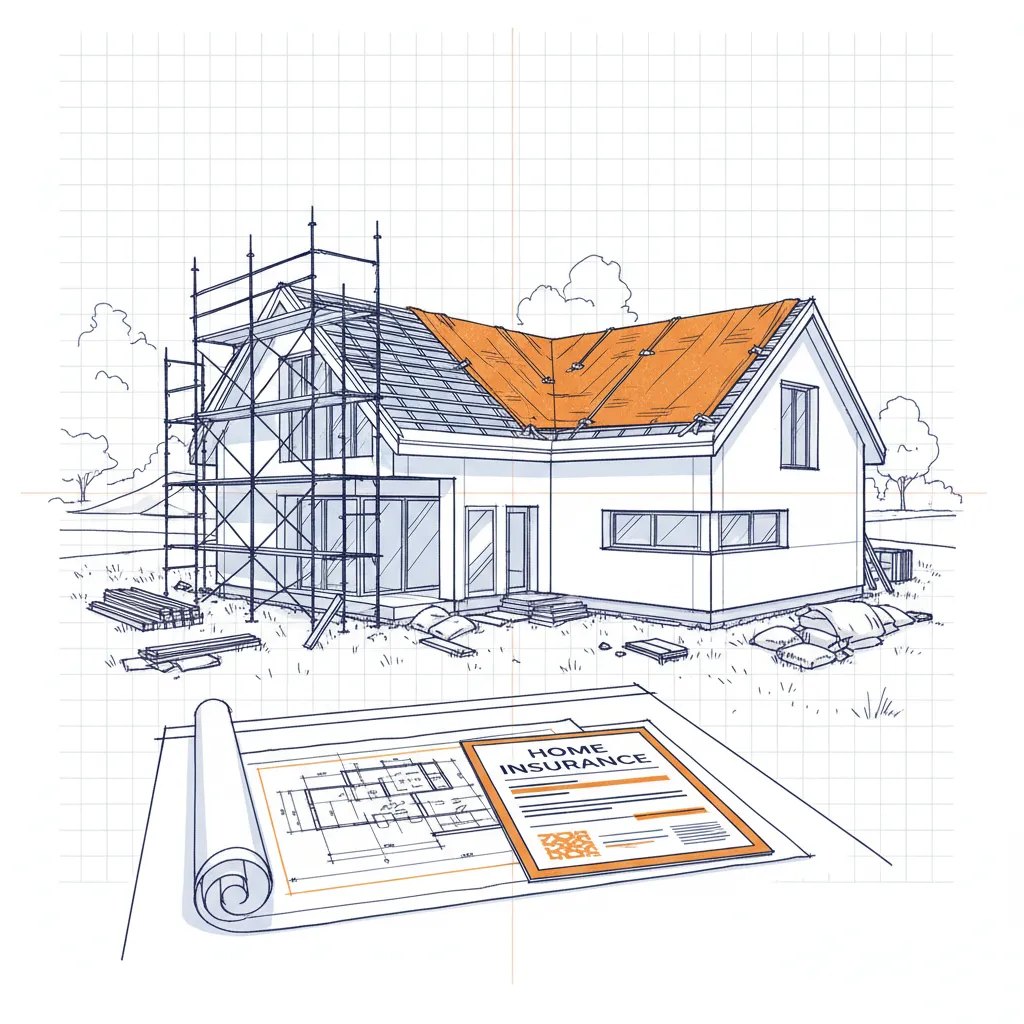
Constructing Your Financial Fortress: The Renovation Risk Blueprint
A major home renovation is a capital investment, not a maintenance task. It fundamentally alters your asset’s value and risk profile. Treating it as a simple construction project exposes your entire financial legacy to structural failure. Your existing insurance policy, the moat around your financial castle, was designed for a finished structure, not a dynamic work site. This blueprint rebuilds your defensive strategy to match your new reality, ensuring your project enhances your legacy, not threatens it.
Moving Beyond ‘Good Enough’: Why Standard Policies Fall Short
A standard homeowner’s policy, a contract designed for a static, occupied dwelling, becomes dangerously inadequate during a renovation. Its core logic assumes a stable replacement cost and predictable liabilities. A major remodel introduces dozens of unaddressed variables. Structural changes increase the property’s replacement value mid-term, leaving your coverage limit insufficient by 20% or more. The presence of contractors and subcontractors introduces significant third-party liability risk that your personal liability coverage was never designed to address. These policies contain specific exclusions for events common to construction sites, creating critical gaps in your financial fortress.
The ‘Paper Legacy’ Risk in Renovation Projects
The ‘Paper Legacy’ Risk is the dangerous gap between the protection you believe you have and the financial reality of a denied claim. This risk materializes when your insurance carrier, uninformed of the renovation’s full scope, rejects a claim based on policy limitations you were unaware of. An electrical fire originating from new wiring or a liability claim from an injured contractor’s employee can be denied if the project created a ‘material change in risk’ not reflected in your policy. This transforms your insurance from a financial shield into a worthless document, forcing you to cover catastrophic losses with your personal assets.
The Four Pillars of Your Renovation Insurance Fortress
Strategic Certainty requires a deliberate, multi-layered defense. A standard policy leaves you exposed. A fortified strategy is built on four distinct pillars of coverage, each addressing a specific phase and risk category of your renovation. This structure ensures cohesion, moving you from 40% partial coverage to the 100% completion goal.
Pillar 1: Fortify Your Foundation with a Dwelling Under Construction Endorsement
A Dwelling Under Construction Endorsement, a critical policy rider, adjusts your property coverage in real-time as the renovation progresses. Standard policies anchor your coverage to the home’s pre-renovation value. This endorsement increases your dwelling coverage limit incrementally, so you can protect the accumulating value of both labor and installed materials. Without it, a total loss halfway through the project would only reimburse you for the original structure, leaving you to personally fund the tens or hundreds of thousands invested in the unfinished work.
Pillar 2: Architect Liability Shields with Contractor’s Insurance Verification
Your personal liability coverage is not a backstop for professional contractors. The primary liability shield must be carried by the general contractor and all subcontractors on your property. Verifying their coverage is a non-negotiable step in your risk management. This involves obtaining a Certificate of Insurance (COI) that names you, the homeowner, as an ‘additional insured’. This status gives you a direct claim to their policy’s protection. We require verification of two core policies: General Liability (for property damage and third-party injury) and Workers’ Compensation (for injuries to their employees). This transfers the primary financial risk from your personal balance sheet to the contractor’s commercial policy.
Pillar 3: Navigate the Vacancy Clause Minefield During Construction
The Vacancy Clause, a standard provision in most homeowner’s policies, suspends or severely limits coverage after a property has been vacant for a set period, typically 30 to 60 days. Insurers view vacant properties as higher risk for vandalism, theft, and undiscovered damage like water leaks. If you move out during the renovation, you could unknowingly trigger this clause, voiding your protection. It is critical to differentiate between ‘unoccupied’ (furnishings present, owner intends to return) and ‘vacant’ (empty of personal property). You must secure a written endorsement from your insurer that explicitly permits the vacancy for the planned duration of the renovation, maintaining full coverage.
| Status | Definition | Default Policy Impact | Strategic Action Required |
|---|---|---|---|
| Unoccupied | The home’s residents are temporarily away, but personal property remains, indicating intent to return. | Coverage is generally maintained, but notification may be required for extended periods. | Inform your advisor of the timeline; confirm in writing. |
| Vacant | The home is empty of people and sufficient personal property to support habitation. | Coverage for theft, vandalism, and water damage is often excluded after 30-60 days. | Secure a Vacancy Permit or Endorsement before moving out. |
Pillar 4: Secure Your On-Site Assets from Theft of Building Materials
High-value materials like lumber, copper wiring, and appliances stored on-site are prime targets for theft. A standard homeowner’s policy may not cover building materials until they are permanently installed. The theft of $20,000 in custom cabinetry or a pallet of hardwood flooring would be an out-of-pocket loss under many policies. A comprehensive renovation strategy includes a specific policy extension for ‘theft of building materials’. This coverage protects your investment from the moment it is delivered to your property, so you can avoid project delays and unbudgeted replacement costs that erode your ROI.
Your Pre-Construction Risk Management Checklist
Execute these three directives before any demolition begins. Proactive strategy is the only effective defense; reactive measures are merely financial damage control.
Execute Coverage Adjustments Before Demolition
Your updated insurance strategy must be in force before the project starts. This includes activating the Dwelling Under Construction endorsement and increasing your overall dwelling limit to reflect the home’s anticipated post-renovation value. We coordinate these policy adjustments with your project timeline and permitting process, so your enhanced protection is in place from day one.
Verify and Document All Contractor Liability Coverage
Do not accept verbal assurances. Obtain the physical or digital Certificate of Insurance (COI) from the general contractor. Confirm that their liability limits are sufficient for your project’s scale, typically a minimum of $1 million per occurrence. Verify that you are listed as an ‘additional insured’. File this document with your project records. This simple act of documentation is a powerful legal and financial tool if a liability event occurs.
Clarify Vacancy and Unoccupancy Terms in Writing
If you plan to vacate the property, engage your strategic advisor immediately. We will secure a written confirmation from the insurance carrier that acknowledges the vacancy and guarantees your policy will remain in full force. This document supersedes the standard vacancy clause in your policy, creating an indisputable record that protects you from a potential claim denial. This written confirmation is your proof of Strategic Certainty.
Building a Cohesive Financial Plan, Not Just a Policy
Insurance is a component of your wealth strategy, not a standalone expense. A renovation is a significant capital event that impacts your net worth, liability profile, and long-term financial trajectory. Integrating this event into your holistic financial plan ensures every decision strengthens your overall position.
Integrate Your Renovation into Your Total Wealth Picture
Your home is a cornerstone asset. A renovation that increases its value by $300,000 must be reflected across your entire financial blueprint. This includes updating your asset allocation, reviewing your estate plan, and adjusting your umbrella liability policy to protect the newly created equity. We analyze the renovation’s impact on your total wealth picture, so you can ensure your risk management strategy scales with your growing asset base, maintaining the integrity of your financial fortress.
Deploy a Strategic Advisor, Not a Faceless Algorithm
A successful renovation demands more than an automatically generated quote. It requires a strategic partner who understands the intersection of construction, finance, and risk management. An advisor performs a comprehensive risk assessment tailored to your project’s specific scope, materials, and timeline. We architect a cohesive protection plan that integrates with your existing assets and goals. This approach delivers Strategic Certainty, transforming your insurance from a reactive commodity into a proactive tool for building and protecting your legacy.